.jpg)







The International Development of Business Schools and Professional Higher Education
Business schools have played an increasingly important role in advanced professional education, particularly since their international expansion during the second half of the twentieth century.
Their success has been based on a distinctive educational model: combining advanced specialist knowledge with the practical experience of senior executives and industry professionals.
Today, universities and business schools offer different forms of advanced education. While universities award officially recognised academic degrees, specialised business schools also provide professional Master’s programmes designed to meet the specific needs of employers and industries.
Today, in accordance with both the Spanish education system (in the case of ITAérea) and the European Education Area, business schools are fully recognised. To obtain such recognition, the following requirements must be met:
a) Official recognition by the Ministry of Finance of each State
Since these institutions are business schools, it is the Ministry of Finance that must recognise or authorise them.
b) Membership in business school associations
These associations only recognise educational institutions that are formally established as business schools.
Professional associations such as the Spanish Association of Business Schools (AEEN), the European Union of Private Higher Education (EUPHE) and the European Foundation for Management Development (EFMD) contribute to international cooperation, professional standards and educational quality.
ITAérea Aeronautical Business School operates within this specialised professional education environment, focusing exclusively on the global aviation industry job-ready skills.
There are also other forms of recognition for business schools that are not essential requirements, such as CUALIFICAM.
1. The Academic and Legal Status of ITAérea’s Master’s Programmes in Spain
ITAérea is a Spanish private educational institution specialising in advanced aviation management and professional training.
Its Master’s programmes are designed to develop specialist knowledge, managerial competencies and practical expertise among aviation professionals.
ITAérea’s Master’s programmes, in accordance with the School’s legal status as a business school, are fully valid within the national and European contexts. Their nature derives from the institution’s legal establishment as a business school, which is distinct from that of a university.
2. What is the legal status of ITAérea’s Master’s Programmes?
ITAérea offers different types of Master’s programmes, including its own programmes and those delivered in collaboration with other institutions.
For example:
- Master in Sustainable Air Transport Management MATSM, offered in collaboration with the United Nations through its agency, UNITAR (United Nations Institute for Training and Research).
- Máster en formación permanente en Gestión y Dirección Aeroportuaria y Aeronáutica, offered in collaboration with the Universidad a Distancia de Madrid (UDIMA).
All other Master’s programmes are delivered directly by ITAérea Aeronautical Business School.
3. The Institution Responsible for Issuing the Final Certificate
The awarding institution depends on the programme selected.
For professional Master’s programmes delivered and certified independently by ITAérea, the final qualification is issued by ITAérea Aeronautical Business School, together with the corresponding academic documentation.
In other cases, the qualification is jointly awarded with the institution with which we have a collaboration agreement, such as the United Nations or the Universidad a Distancia de Madrid (UDIMA).
Prospective students should therefore verify the awarding institution, exact qualification title and applicable academic status before enrolling.
4. ECTS Credits and the Relationship Between Programme Hours and Academic Credits
The European Credit Transfer and Accumulation System (ECTS) provides a common framework for describing the workload and learning outcomes associated with higher education.
Under the European model, 60 ECTS credits generally represent one full academic year, equivalent to approximately 1,500 hours of total student workload.
Accordingly, one ECTS credit normally corresponds to approximately 25 hours, including teaching, independent study, practical assignments and assessment, as explained in the European Commission’s ECTS Users’ Guide.
ITAérea’s programmes vary in duration and academic structure.
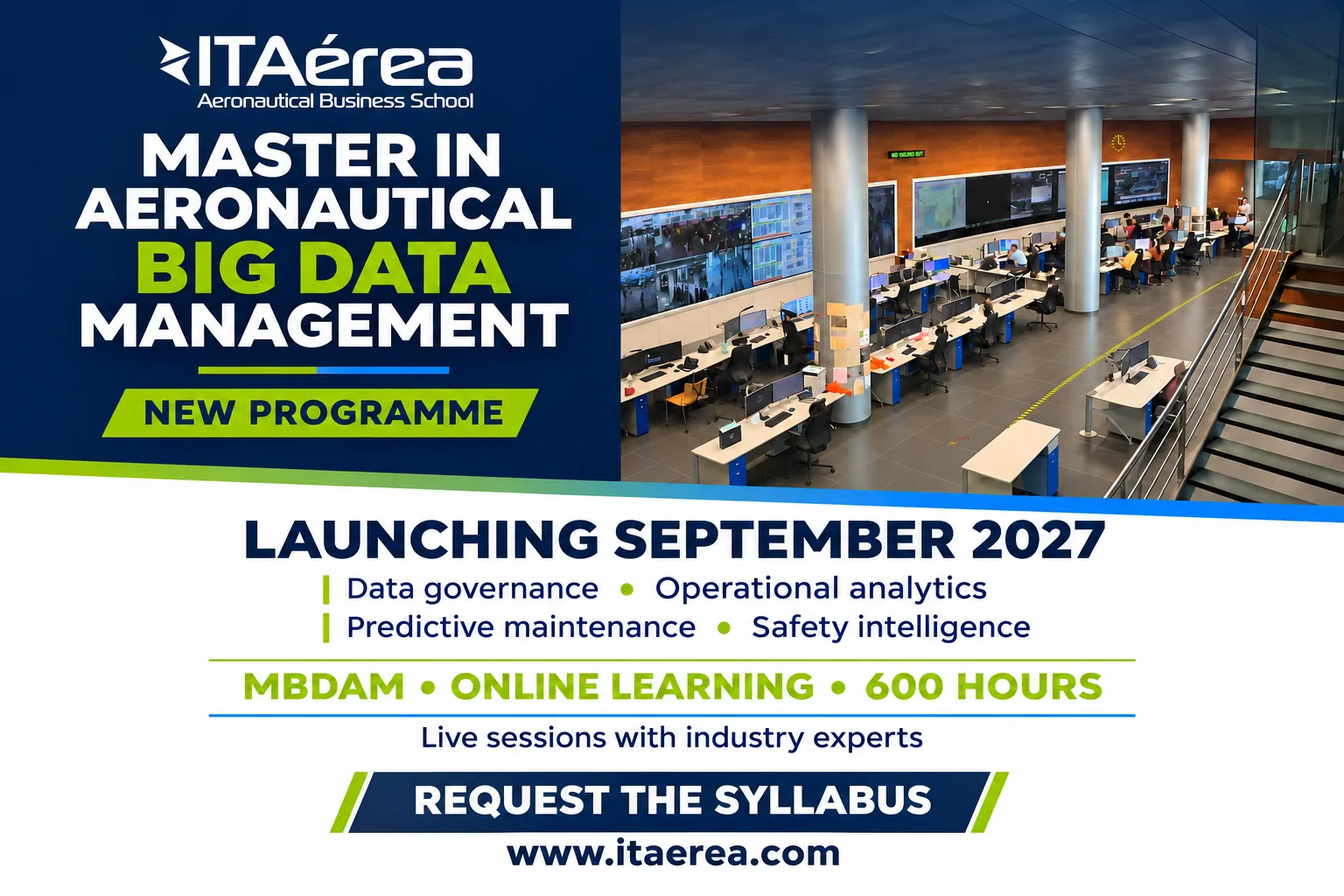
For example, the School delivers its face-to-face Máster en Gestión y Dirección Aeroportuaria y Aeronáutica with a workload of 1,500 hours and 60 ECTS credits. Other specialist programmes are delivered with different durations, including 600-hour programmes.
The number of hours does not automatically establish a formally recognised ECTS allocation.
Any ECTS credits stated for a particular programme must be supported by its academic documentation and applicable awarding or quality-assurance arrangements.
Similarly, completing a programme of a given duration does not automatically confer official university Master’s status.
5. Further Academic Progression and Doctoral Studies
ITAérea’s professional Master’s programmes can support career development and provide valuable preparation for further specialised study.
Students may apply to continue their studies through university doctoral programmes. They should consult the specific admission requirements of each university. Depending on the applicant’s prior qualifications, programme content and applicable regulations, a university may evaluate previous learning and professional experience for possible recognition.
In addition, we are aware that many ITAérea alumni have applied to PhD programmes and got successfully admitted. As mentioned earlier, this would entirely depend on the admission requirements of the receiving university.
6. Apostille and Legalisation Procedures for International Use
ITAérea graduates who wish to present their qualifications internationally may need to authenticate their documents for use in another country.
The appropriate procedure depends on the legal nature of the document and the requirements of the destination country, as explained by the Spanish Ministry of Foreign Affairs in its official guidance on legalisation and apostilles.
For private educational qualifications issued in Spain, this may involve notarisation or notarial certification of the relevant signature, followed by the corresponding apostille or legalisation procedure.
Where the destination country participates in the Hague Apostille Convention of 5 October 1961, an apostille can simplify the international authentication process.
For countries outside the Convention, diplomatic or consular legalisation may be required.
An apostille confirms the authenticity of the relevant signature, capacity or seal.
Students should confirm the specific requirements with the authority, employer or institution receiving the document.
7. Acceptance and Professional Value Among Employers, Aviation Authorities and International Organisations
The professional value of ITAérea’s qualifications lies in their sector-specific focus, international reach and close connection with the aviation industry.
Unlike general management education providers, ITAérea concentrates on airport management, airline operations, air navigation, aviation safety, aerospace management and other specialised areas of air transport.
Its teaching model draws on active senior executives and aviation professionals, helping students connect advanced knowledge with the challenges faced by the industry.
The School’s international standing is reinforced by documented relationships with major aviation organisations.
Recognition and Collaboration with ICAO
ITAérea is listed in the official training catalogue of the International Civil Aviation Organization (ICAO) as a Corporate Partner and private training institution.
Its collaboration with ICAO includes aviation training initiatives and courses included in ICAO’s training catalogue.
In 2025, ICAO and ITAérea also collaborated on a scholarship initiative aimed at aviation professionals from developing Member States.
These relationships provide important evidence of the School’s engagement with international aviation training and professional development.
Recognition and Collaboration with Airports Council International
ITAérea also identifies itself as an accredited training partner of Airports Council International (ACI World) and reports educational collaboration with ACI’s regional organisations.
These partnerships strengthen the School’s connection with airport management professionals, international industry practices and specialist executive education.
The value attributed to an ITAérea qualification by an individual airline, airport operator, aviation authority or international organisation depends on its own recruitment policies, professional requirements and applicable regulations.
Recognition and Collaboration with the United Nations Institute for Training and Research (UNITAR)
The United Nations Institute for Training and Research (UNITAR) is the training and capacity-development arm of the United Nations. Its mission is to bridge the knowledge and skills gaps through impactful training, research and innovative learning solutions across peace, diplomacy, sustainable development, and effective governance.
ITAérea Aeronautical Business School maintains a longstanding educational partnership with the United Nations Institute for Training and Research (UNITAR) and CIFAL Mérida, an international training centre within the UNITAR network.
Through strategic partnerships and learning platforms, UNITAR builds the skills of individuals and enhances the capacities of institutions and organizations, particularly those in vulnerable contexts, to accelerate progress towards the 2030 Agenda for Sustainable Development and the Pact for the Future.
The three institutions signed a trilateral cooperation agreement at the United Nations Palace of Nations in Geneva in November 2017, aimed at developing specialised air transport training aligned with the United Nations 2030 Agenda and its Sustainable Development Goals (SDGs).
The partnership was subsequently extended in May 2018 to facilitate access to ITAérea’s online training programmes through the international CIFAL network, and renewed on 6 November 2023 in Miami, reinforcing their commitment to professional development and sustainable aviation management.
This collaboration has also included a Master’s programme jointly issued by ITAérea and UNITAR, demonstrating the institutions’ shared commitment to developing internationally oriented aviation professionals and future industry leaders.
A Global Aviation Business School
ITAérea has developed a substantial international educational network.
The School operates through 23 offices across four continents, has more than 400 teachers and serves over 2000 students annually.
The School is the world’s largest specialised aviation business school by student numbers, international presence and faculty size.
Its international presence and specialist teaching model position it as a significant provider of professional education for the aviation industry.
Conclusion: professional excellence with International reach
ITAérea Aeronautical Business School combines specialised aviation education, executive-level teaching and an extensive international network.
Its professional Master’s programmes provide advanced industry-oriented qualifications, while selected programmes benefit from independent quality certification or specific university awarding arrangements.
Understanding these distinctions allows students and employers to assess each qualification accurately, considering its awarding institution, academic status, professional scope and potential for further study.
ITAérea’s principal strength is its ability to connect advanced aviation education with the real operational and managerial needs of a global industry.
Through its specialist academic programmes, international partnerships and experienced faculty, the School contributes to preparing aviation professionals for leadership, innovation and the challenges of tomorrow’s air transport sector.