


In this article we are going to address different issues that will give us a global vision of airports and their operation. In addition to getting to know some of the most representative airports on the national and international scene.
Index
We can define an airport as all that land where we can find facilities and runways for takeoff, landing and aircraft traffic, as well as maintenance, refueling, boarding and disembarking of passengers, etc.
It should be said that an airport has an infinite number of different facilities, services, buildings throughout its entirety, but we can divide it into two parts:
TRAINING ON AIRPORTS: REQUEST INFORMATION
Airport services are those services provided by airport service operators, the airport manager or collaborating companies that operate in the airport infrastructure. We can distinguish between services aimed at aircraft and services aimed at passengers, which we could divide between airport services and passenger/commercial services.
Airport services include services of:
The types of airports according to their main activity are civil, general aviation and air cargo airports. We will see the characteristics of each one:
Airports are essential for the economic development of any place. They improve communications, lead to the creation of jobs, generate economic activity and revalue the environment. The globalization of today's world makes it essential for society to be able to use air transport both for business and leisure reasons. Airports occupy the first place of importance in tourist and business activities in each country.
The globalization of today's world makes it essential for society to be able to use air transport both for business and leisure reasons. Airports occupy the first place of importance in tourist and business activities in each country.
Estimated time of arrival (also known as ETA) is defined as the period of time a certain flight is expected to arrive at the destination airport.
Next, we are going to answer different questions about how to work in airports. To do this, it is necessary to know that the main jobs at airports can be divided into three large groups:
Ramp Services (Handling): assistance to aircraft to be able to offer the services necessary for the operation of flights. The main positions that exist are: flight coordinator, ramp agent (bags), gateway operators, check-in staff, fuel supply staff.
To work in these positions, not much training is required; internal training is usually carried out in companies. They usually hire auxiliary Handling companies (Swissport, Groundforce, Aviapartner, Lesma, etc.) or the airlines themselves with their Handling subsidiaries (Iberia, Azul Handling (Ryanair), Easyjet, Lufthansa, etc.).
Commercial and auxiliary services: work in airport businesses: stores, cafes, etc. No training is required for these positions, they hire the businesses themselves who can put you to work on Gran Vía in Madrid, but for the airport stores.
We can also find cleaning staff, information points, etc.
Technical positions in the sector: technical positions related to airport operations. We can find the staff of the airport manager, in the case of Spain AENA, staff from companies hired by the airport manager (AERTEC, Vanderlande, etc.) that usually work on quality projects, maintenance, operations, etc.
To work in these positions, university studies are usually required, mainly engineers and aeronautical managers, but also studies in finance and law.
At ITAérea we have the best training and the best courses to work at the airport.
COURSES TO WORK AT THE AIRPORT
It is popularly known that, in 1903, the Wright brothers, Orville and Wilburg, made the first flight in history in an airplane in North Carolina, USA. This flight took off from an esplanade that had nothing to do with an airport of course.
Years later, in 1909, the same protagonists mentioned above launched the project that is considered the first airport in the world. So what was the first airport in the world? Located in Maryland, near the American capital, College Park Airport (which is still operational) became this first airport, consisting at that time of a runway marked with lime, some hangars with fuel tanks and a rather primitive platform where they boarded. the passengers.
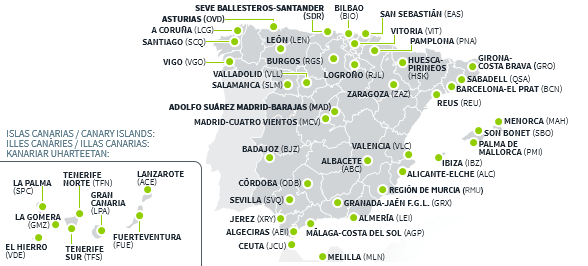
Below is the map of the airports in Spain located on Spanish territory accompanied by their IATA code, for example: Asturias (OVD).
The main airports in Europe by number of passengers in 2019 and connectivity are:
The main airports in Europe by number of passengers in 2019 and connectivity are:
The smallest airport in the world is Yrausquin, located on Saba, a Caribbean island belonging to the Netherlands. It has a track of only 400 meters of asphalt.
Airports can be built on the sea for different reasons:
If the flight is domestic, many airlines consider that the time it takes to get to the airport to avoid any setbacks is between 45 and 90 minutes. However, if the flight is international, it is advisable to arrive at the airport more time in advance, between 2 and 3 hours before the flight departure time, since different controls must be passed than on domestic flights, like the passport, for example.
The flight departure time should not be confused with the boarding gate closing time. Many airlines close their boarding gates 15 to 30 minutes before the flight departure time. Therefore, just because the flight departure time is at a certain time, does not mean that you can show up at the last minute to board the flight.
The sterile area of an airport is that area between an inspection post and the plane. Its access is fully controlled and is used so that passengers remain waiting for a flight.
The restricted security zone is defined as any area or space of an airport whose access is subject to access control and security control. This zone includes the airport area to which passengers who are waiting to board and who have passed the security check have access, and the airport area used for parking aircraft destined for loading or boarding operations.
An airport is international when it has customs and immigration facilities that allow the management of international flights with other countries.
CONTACT info@itaerea.es +34 902 505 501 TEACHERS MASTERS & COURSES