.jpg)






Market guide · Reading time ~10 min · Context reviewed on 25 September 2026
By the ITAérea faculty
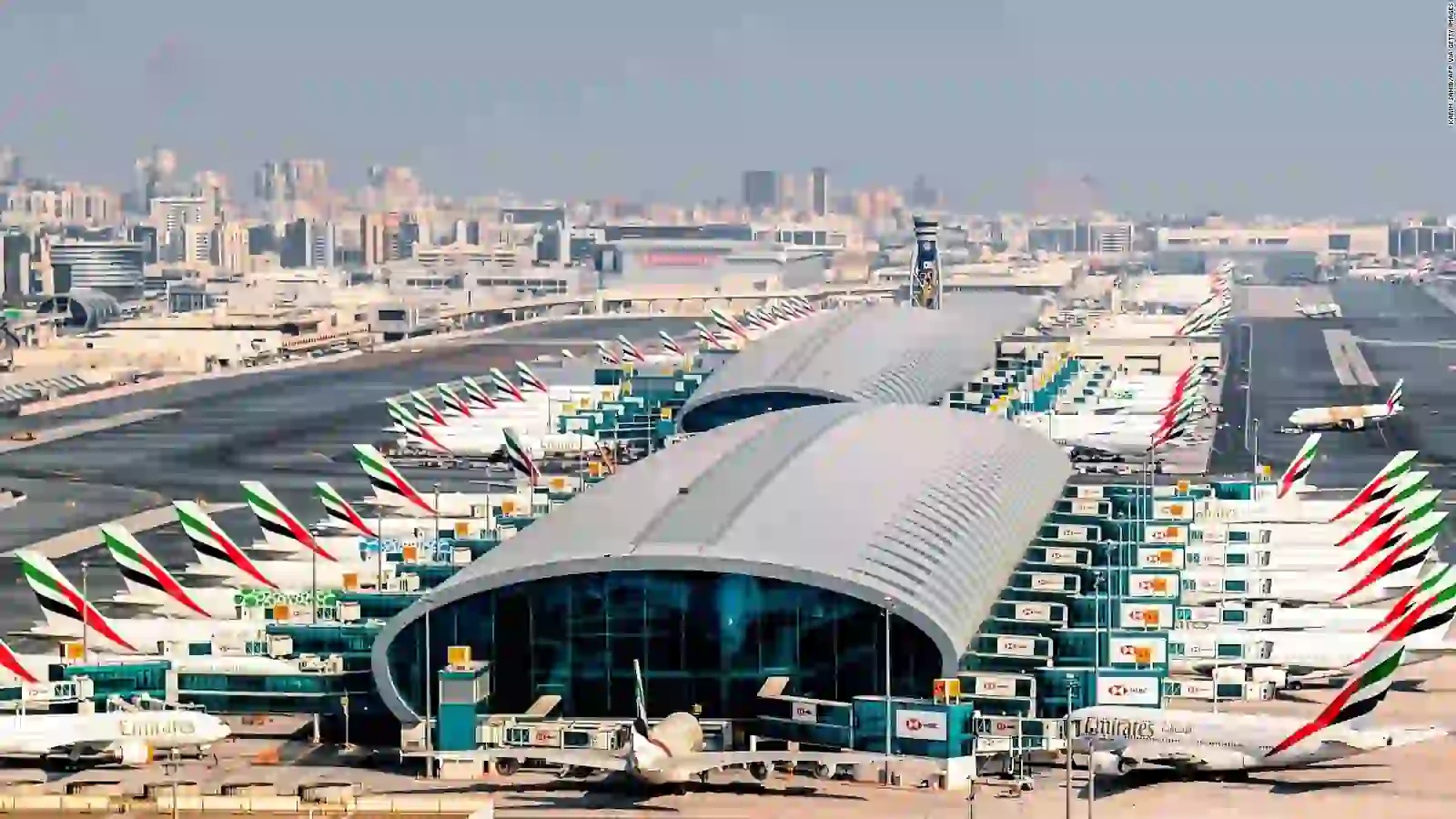
In August 2026, with Dubai’s traffic still below 2025 levels because of the regional conflict, Dubai Airports announced more than 55 billion dirhams (AED) in contracts for its new airport before the end of the year. Uncertainty today, investment over the next ten years. If you are considering working at Dubai Airport or in Saudi Arabia in management or engineering, this guide explains who hires, what you will be asked for, how the visa works, how pay packages are structured and what has changed in 2026. We write it as an aviation business school with headquarters in both countries.
Quick answer
- At Dubai Airport, dozens of separate companies hire: the operator, airlines, ground handling, air navigation and construction.
- You need a firm job offer: the employer applies for the work permit and the visa. You cannot work on a tourist visa.
- Professional English, a legalised degree and demonstrable experience.
- The United Arab Emirates (UAE) has no personal income tax, but check your tax residence in your home country.
- In 2026 the region is affected by a conflict: check official travel advice before you decide.
Who hires at Dubai Airport? Not a single company
At Dubai Airport, “the airport” does not hire: an ecosystem of independent companies does, each with its own careers portal, selection process and visa sponsorship. Dubai Airports, the operator, is only one of them.
| Employer | What it does | Profiles it hires | Where to apply (official portal) |
|---|---|---|---|
| Dubai Airports | Operates Dubai International (DXB) and Al Maktoum International (DWC) | Operations, infrastructure, technology, corporate | careers.dubaiairports.ae |
| Emirates Group (Emirates and dnata) | Flag carrier, plus ground, cargo and catering services | Operations, engineering, planning, commercial, finance, cabin crew | emiratesgroupcareers.com |
| flydubai | Airline based at DXB | Operations, maintenance, planning, cabin crew | Careers section of its official website |
| DANS (Dubai Air Navigation Services) | Air navigation services for Dubai | Air traffic control, systems engineering, safety | Careers section of its official website |
| DAEP (Dubai Aviation Engineering Projects) and contractors | Delivers the works for the new Al Maktoum | Project management, engineering, architecture, contract management | Official websites of DAEP and of each contractor |
| Companies on the airport site | Retail, concessions, MRO (maintenance, repair and overhaul), consultancies | Commercial management, maintenance, consultancy | Each company’s portal |
Dubai Airports: the operator of DXB and the new Al Maktoum
Dubai Airports runs DXB and DWC, its future replacement. Its careers portal has three areas, Service & Operations, Technology & Infrastructure and Corporate: operations suits someone from a busy airport, such as an Aena airport in Spain, Mexico City International Airport (AICM) or an African or Middle Eastern hub; infrastructure suits engineers.
Working for Emirates, dnata and flydubai: airlines and ground services
Anyone searching for “working for Emirates” pictures the cabin. That said, the Emirates Group is above all a ground employer, with dnata in ground handling and cargo, plus engineering and corporate functions. If you want to become cabin crew, the process is on its portal; if you already are, read how to move from cabin crew to management.
Air navigation, authorities and construction: DANS, GCAA, DCAA and DAEP
DANS provides air navigation services in Dubai. The GCAA (General Civil Aviation Authority, the UAE’s federal regulator) and the DCAA (Dubai Civil Aviation Authority) regulate and oversee. DAEP is delivering the new Al Maktoum, and its contractors account for a large share of the construction jobs.
Where to find Dubai Airport job offers (and how to spot fake ones)
Reliable Dubai Airport job offers are on the official portals in the table, on LinkedIn and with specialist aviation recruiters. What few people mention: fake offers circulate. If you are asked to pay for an application, a visa or a medical examination, be wary.
Which profiles Gulf airports are looking for
Gulf airports look to foreign professionals for specialised experience that the local market does not yet produce at scale: operations and terminal management, project management, engineering and licensed technical roles. Some positions and programmes are reserved for nationals.
| Profile | Example roles | What they usually ask for | Fit for an international professional (for example, from Spain or Latin America) |
|---|---|---|---|
| Management and operations | Operations planning, terminal, operations control centre, commercial and non-aeronautical revenue, safety, finance | Experience at high-traffic airports, international standards, professional English | High if you come from a hub or a growing airport (Aena, El Dorado in Bogotá, AICM in Mexico City, Jorge Chávez in Lima or a comparable hub) |
| Engineering, architecture and projects | Project management, planning, contract management, design coordination, commissioning | Large infrastructure, work with international contractors, project methodologies | High on the megaprojects at DWC and in Riyadh |
| Licensed technical roles | Air traffic control, aircraft maintenance, security | Licence validated by the local authority | Medium: depends on validation |
| Roles reserved for nationals | Graduate programmes, some corporate roles | Emirati or Saudi nationality | No fit: Emiratisation and Saudisation quotas |
Management and operations: the airport executive’s home ground
The natural territory of a manager from Spain, Latin America or any large aviation market: operations planning, terminal, operations control centre, commercial, finance and safety through an SMS (Safety Management System, required by ICAO, the International Civil Aviation Organization).
Engineering, architecture and project management: the gateway to the megaprojects
Here is the nuance. DWC in Dubai and King Salman International Airport (KSIA) in Riyadh will need project management, contract management and commissioning for years. According to The National (26 August 2026), around 9,000 people work on the DWC site, with up to 120,000 at the peak. A niche to watch: ORAT (Operational Readiness and Airport Transfer), the discipline that prepares the opening or relocation of a terminal.
Licensed technical roles: air traffic control, maintenance and security
Air traffic controllers and maintenance technicians can work in the Gulf, but a licence does not travel on its own. Whether issued under EASA (European Union Aviation Safety Agency) rules, by the US FAA (Federal Aviation Administration) or by another authority, it must be validated by the GCAA in the UAE or GACA (General Authority of Civil Aviation) in Saudi Arabia.
Emiratisation and Saudisation: roles reserved for nationals
Both countries reserve roles and programmes for their citizens: Dubai Airports runs Future Faces for Emirati graduates, and Saudi Arabia applies its own Saudisation policy. The result? Expatriates do not compete for those roles; they compete on specialised experience.
Requirements for working at Dubai Airport
To work at Dubai Airport you need a firm offer from an employer who will sponsor your permit, a degree legalised for use in the UAE, demonstrable experience and professional English. None of this depends on your nationality; what changes is the paperwork.
A firm offer from an employer who sponsors you
The UAE uses a sponsorship model: the employer applies for the permit, and without it there is no visa. The travel advice of Spain’s Ministry of Foreign Affairs (in Spanish) sums it up: “Emirati laws prohibit holders of a tourist visa from working and require those who wish to work in the UAE to obtain a work permit beforehand” (our translation).
A legalised degree and demonstrable experience
Saudi Arabia has been a party to the Apostille Convention since 7 December 2022: if your degree was issued in another party country, an apostille is enough. For the UAE, check the current procedure with its embassy before you start. Experience is proven through verifiable roles and projects.
Executive tip. It would be wise to start legalising your degree before you have an offer: a selection process moves in weeks, and the procedure can take longer.
Do you need English to work in Dubai? What about Arabic?
Yes: English is the working language of aviation in the Gulf. Arabic is not mandatory for most management and engineering roles, but it is valued and some vacancies require it. If your English is not yet technical, start with this guide to technical aviation English.
Requirements by country: Spain, Mexico, Colombia, Peru and Argentina
To the point: the employer applies for the permit regardless of your nationality. What changes is how you legalise your degree, whether you need a visa to travel to an in-person interview, and your tax situation at home.
| Country | Degree for Saudi Arabia | Degree for the UAE | Tax at home | Where to ask |
|---|---|---|---|---|
| Spain | Hague Apostille | Check with the UAE embassy | Double taxation agreements with the UAE and with Saudi Arabia (Spanish Tax Agency, AEAT, in Spanish) | UAE and Saudi embassies accredited to Spain |
| Mexico | Hague Apostille | Check with the UAE embassy | Check with the SAT (Mexico’s tax administration) | UAE and Saudi embassies accredited to Mexico |
| Colombia | Hague Apostille | Check with the UAE embassy | Check with the DIAN (Colombia’s tax and customs authority) | UAE and Saudi embassies accredited to Colombia |
| Peru | Hague Apostille | Check with the UAE embassy | Check with the SUNAT (Peru’s tax authority) | UAE and Saudi embassies accredited to Peru |
| Argentina | Hague Apostille | Check with the UAE embassy | Check with the national tax authority | UAE and Saudi embassies accredited to Argentina |
From another country? Check the Apostille Convention status table of the HCCH (Hague Conference on Private International Law), the UAE and Saudi embassies accredited to your country and your own tax authority.
How the Dubai work visa works, step by step
The Dubai work visa is obtained in four stages, all started by the employer: work permit, entry permit, medical examination and residence visa with Emirates ID. Official source: Residence Visa for Work on dubai.ae.
The four stages of the work visa
1. Work permit from the MOHRE
Once the offer is signed, the employer applies to the MOHRE for a work permit in your name, valid only for that company.
2. Entry permit
Once the work permit is approved, an entry permit is issued for you to travel to the UAE. If you are already in the country, your status is changed without leaving.
3. Medical examination and biometric data
Once in Dubai, you undergo a medical examination at an approved centre and register your biometric data.
4. Residence visa and Emirates ID
The residence visa and the Emirates ID, your identity document in the country, are then issued.
Green visa and Golden Visa: when they are worth considering
That said, some qualified profiles can live in the UAE without a sponsor: the green visa and the Golden Visa remove the dependence on one company, which helps if you change employer. Their requirements change by regulation: check the current ones on the UAE Government’s official portal.
Work visa in Saudi Arabia: Qiwa and iqama
In Saudi Arabia, the logic is the same under different names: the employer starts the process on Qiwa, the platform of the Ministry of Human Resources and Social Development, and obtains the iqama, the residence permit.
Middle East aviation salaries: how much you can earn at Dubai Airport
How much you can earn at Dubai Airport depends on the profile, the employer and the whole package, not only the salary. There is no single public pay scale: each company negotiates, and the benchmarks are recruiters’ salary guides, with source and year.
How a salary package is structured in the Gulf
In the Gulf, pay is a sum of parts: basic salary, housing, transport, an annual flight home, health insurance and an end-of-service gratuity. Comparing only the total is misleading: part of the package is in kind.
Executive tip. Ask what the end-of-service gratuity is calculated on: if it is the basic salary, it is worth negotiating the basic salary and not only the overall figure.
For leadership roles, see our analysis of how much an airport manager earns.
Do you pay tax when working in Dubai? The tax residence caveat
The UAE does not levy personal income tax, as confirmed by the UAE Ministry of Economy and Tourism. For Saudi Arabia, check the current tax rules.
Warning: not paying tax in the Gulf does not mean you stop being tax resident at home. In Spain, residence is determined by the criteria in Article 9 of Law 35/2006 on Personal Income Tax (IRPF), and Spain has double taxation agreements (DTAs) with the United Arab Emirates and with Saudi Arabia (Spanish Tax Agency, in Spanish). Elsewhere, check your own country’s residence rules and tax treaties. This section is for information only and does not constitute tax advice: consult an adviser before you move.
Airport projects in the Middle East: from Al Maktoum to King Salman International Airport in Riyadh
The airport projects in the Middle East that will be hiring over the next decade are, above all, the new Al Maktoum in Dubai and King Salman International Airport in Riyadh, plus the reorganisation of the Saudi airport system.
Al Maktoum International (DWC): the airport that will replace DXB
The Government of Dubai approved the new DWC terminal at a cost of AED 128 billion, about USD 34.9 billion or EUR 30.7 billion, for a final capacity of 260 million passengers; the first phase, for 150 million, is due in 2032. According to The National (26 August 2026), around AED 13 billion has already been awarded (about USD 3.5 billion or EUR 3.1 billion) and Dubai Airports expects to exceed AED 55 billion (about USD 15 billion or EUR 13.2 billion) before the end of 2026: construction has not slowed down.
King Salman International Airport in Riyadh: six runways for Vision 2030
King Salman International Airport (KSIA) is the centrepiece of Vision 2030 in aviation. According to the official announcement by the Saudi Press Agency (SPA) on 28 November 2022, it will cover about 57 square kilometres, have six parallel runways and aims to handle 120 million travellers by 2030 and 185 million by 2050.
The Saudi strategy: new airlines and privatised airports
Saudi Arabia is not building one airport: it is reorganising a system. GACA’s Saudi Aviation Strategy sets targets for 2030, groups airports under Matarat Holding and into clusters for privatisation, and has seen the launch of Riyadh Air. The sector meets at the Future Aviation Forum in Riyadh, organised by GACA (third edition: 20–22 May 2024).
What has changed in 2026: the regional conflict and air traffic
As of 25 September 2026, a regional conflict is affecting air traffic and travel advice. The travel advice of Spain’s Ministry of Foreign Affairs for the United Arab Emirates, updated on 15 July 2026, states: “The Near East region is affected by a conflict of regional scope. You are advised to postpone your trip to the UAE unless it is necessary”, and adds that “the United Arab Emirates (UAE) is an internally stable and safe country”. The advice for Saudi Arabia, updated on 10 June 2026, is along the same lines: “Saudi Arabia’s airspace is open” and “You are advised to postpone your trip to Saudi Arabia unless it is necessary” (our translations; pages in Spanish).
According to Dubai Airports, via the UAE’s state news agency WAM, DXB handled 31.5 million passengers in the first half of 2026, down 31.3% year on year, with a month-on-month recovery: 3.5 million in April, 4.5 million in May and 5 million in June. Before signing, ask the employer about its contingency plan. If you are Spanish, register with the Ministry’s Registro de Viajeros (Travellers’ Register); if you hold another nationality, read your own government’s current travel advice for both countries before deciding.
Is it better to work in Dubai or in Saudi Arabia?
There is no universal “better”: Dubai suits those who want to operate a mature hub, which according to Dubai Airports handled 95.2 million passengers in 2025; Saudi Arabia suits those who want to join new projects and organisations that are still taking shape.
| Criterion | Dubai (UAE) | Saudi Arabia |
|---|---|---|
| Market maturity | Established hub: 95.2 million passengers at DXB in 2025 (Dubai Airports) | System in full expansion and reorganisation |
| Type of opportunity | Operating and improving what already works; DWC construction | Building from scratch: KSIA, clusters, new airlines |
| Typical employers | Dubai Airports, Emirates Group, flydubai, DANS, DAEP and contractors | GACA, Matarat, Riyadh Airports, Riyadh Air, KSIA contractors |
| Work visa | The employer applies to the MOHRE | The employer applies through Qiwa; result: iqama |
| Degree legalisation | Check with the UAE embassy | Hague Apostille (since 7 December 2022) |
| Roles reserved for nationals | Emiratisation | Saudisation |
| Working language | English; Arabic valued | English; Arabic more present day to day |
| Personal income tax | None (UAE Ministry of Economy and Tourism) | Check current rules |
| Travel advice of Spain’s Ministry of Foreign Affairs, September 2026 | Postpone travel unless necessary | Postpone travel unless necessary |
Qatar, Oman, Kuwait and Bahrain follow a similar logic, but they are outside the scope of this guide.
How to position yourself for a management role at a Gulf airport
What counts in an application: international experience, ICAO/ACI standards and networking
Three things count: verifiable experience at a high-volume airport or on a major infrastructure project; command of ICAO and ACI (Airports Council International) standards; and a network, built at events such as the Dubai Airshow or the Future Aviation Forum, where decision-makers meet. And prepare for the interview with this guide on how to succeed in an airport job interview.
Training as a lever: what we do in the region
We work in both countries: we have headquarters in Dubai and headquarters in Saudi Arabia, from where we maintain collaboration agreements with GACA and with SACA (Saudi Academy of Civil Aviation). We are a Corporate Partner of ICAO’s TRAINAIR PLUS programme, an ACI World accredited training centre and a strategic partner of UNITAR (United Nations Institute for Training and Research).
At the Dubai Airshow 2025 we signed a memorandum of understanding with Dubai Air Navigation Services. On 1 November 2023 we delivered the workshop for senior Saudi airport managers Airports of the Future to more than 70 executives from MATARAT, DACO, Cluster 2 and JEDCO. And on 16 May 2023 we held a meeting with the President of GACA.
One of the career paths we have covered, back in 2019, is Mamen Alonso’s move to Air Arabia: MGDA Executive (2017–2019, Madrid), Iberia Express and then Air Arabia, an airline based in Sharjah, as Senior Revenue Optimisation Executive. We train for those roles with our Diplomado Internacional en Gestión Aeroportuaria (international diploma in airport management; 120 hours, e-learning) and with our Máster en Gestión y Dirección Aeroportuaria y Aeronáutica (MGDA, master’s in airport and aeronautical management), in the classroom and also online.
Frequently asked questions about working at Dubai Airport
Can I go to Dubai on a tourist visa to look for work?
You can travel and attend interviews, but you cannot work: the UAE travel advice of Spain’s Ministry of Foreign Affairs (in Spanish) notes that “Emirati laws prohibit holders of a tourist visa from working” (our translation). If you receive an offer while there, the employer applies for the permit and the change of status.
Is it safe to work in Dubai in 2026?
As of 25 September 2026, Spain’s Ministry of Foreign Affairs describes the UAE as “an internally stable and safe country”, but advises travellers “to postpone their trip to the UAE unless it is necessary”, as it does for Saudi Arabia (our translation). Read the current advice on the day you decide and ask the employer about its contingency plan.
Do I need airport experience to work at Dubai Airport?
For management and engineering roles, yes: experience at airports or on major infrastructure projects is valued. Having managed operations at an Aena airport in Spain, at El Dorado in Bogotá, at Mexico City’s AICM, at Jorge Chávez in Lima or at a comparable hub is a credential that Gulf recruiters understand and check.
What happens to my visa if I lose my job?
Your residence visa depends on the employer that sponsored it: if you lose your job, your immigration status changes; check the current rules through official channels before signing. A green visa or a Golden Visa removes that dependency.
Conclusion: the Gulf rewards those who arrive prepared
At Dubai Airport there is no single employer; there is an ecosystem. Without a firm offer there is no visa, so your application starts before you buy a ticket: a legalised degree, technical English and verifiable experience. And the horizon is not this week’s vacancy but the ten years of construction at Al Maktoum and King Salman, in a region where official travel advice has to be read carefully today. Working at Dubai Airport or in Saudi Arabia is a real career step for those who arrive prepared.
Would you like to see how we work in Dubai, in Saudi Arabia and at our other international locations? Explore our headquarters.