.jpg)







Study guide · Reading time ~8 min
By the ITAérea faculty · Updated: October 2026
“If I study online, who am I going to meet?” It is the question we hear most often from people who work at airports, airlines or ground handling companies and want to train without leaving their job. It is a fair question: aviation is a small, global and highly relationship-driven industry. The short answer is that networking in an online master’s does happen, but differently: it does not arise over coffee, you make it happen. We are talking about master’s programmes in aviation and airport management, not engineering. You will see which myths fall apart, how our online training works, a five-step method and, at the end, eight questions to compare programmes.
In 30 seconds
- You can network in an online master’s, but it takes more initiative than in a classroom.
- You gain reach (classmates from other countries and other links in the industry chain) and lose spontaneous contact.
- What matters most: live sessions with lecturers from the industry, and your own participation.
- Before you choose, ask about live sessions, group work and alumni.
Myths and facts about studying aviation management online
Studying aviation management online does not cut you off from the industry, but it changes how you build contacts. Networking in an online master’s is the professional network you build with lecturers and classmates during the programme. It does not appear on its own: it depends on what you do in each session.
Myth 1: “In an online master’s you don’t get to know anyone”
It is true that there is no corridor and no coffee between classes. What is false is that you meet no one: you study alongside professionals from other countries and areas of the industry, and in live sessions you talk to the people who teach.
You meet different people, not fewer people. The key? Make the first move yourself, as you will see in the method.
Myth 2: “Online means studying alone with recorded videos”
Students will have access to live sessions and supplementary material provided by the lecturer, available on the academic campus.
What to do: ask whether there are live classes and how often.
Myth 3: “With shifts and travel, you can’t keep up with a master’s”
This is the myth with the most truth in it: shifts, on-call duty and travel complicate any study plan. Students will be provided with the academic material from the teacher, followed by a live session with the teacher.
What to do: block the live sessions in your calendar as one more shift.
The live sessions will take place at 6.00 pm Madrid time, so we can cater for all time zones. They are held two or three times a week.
Myth 4: “An online master’s is worth less to recruiters”
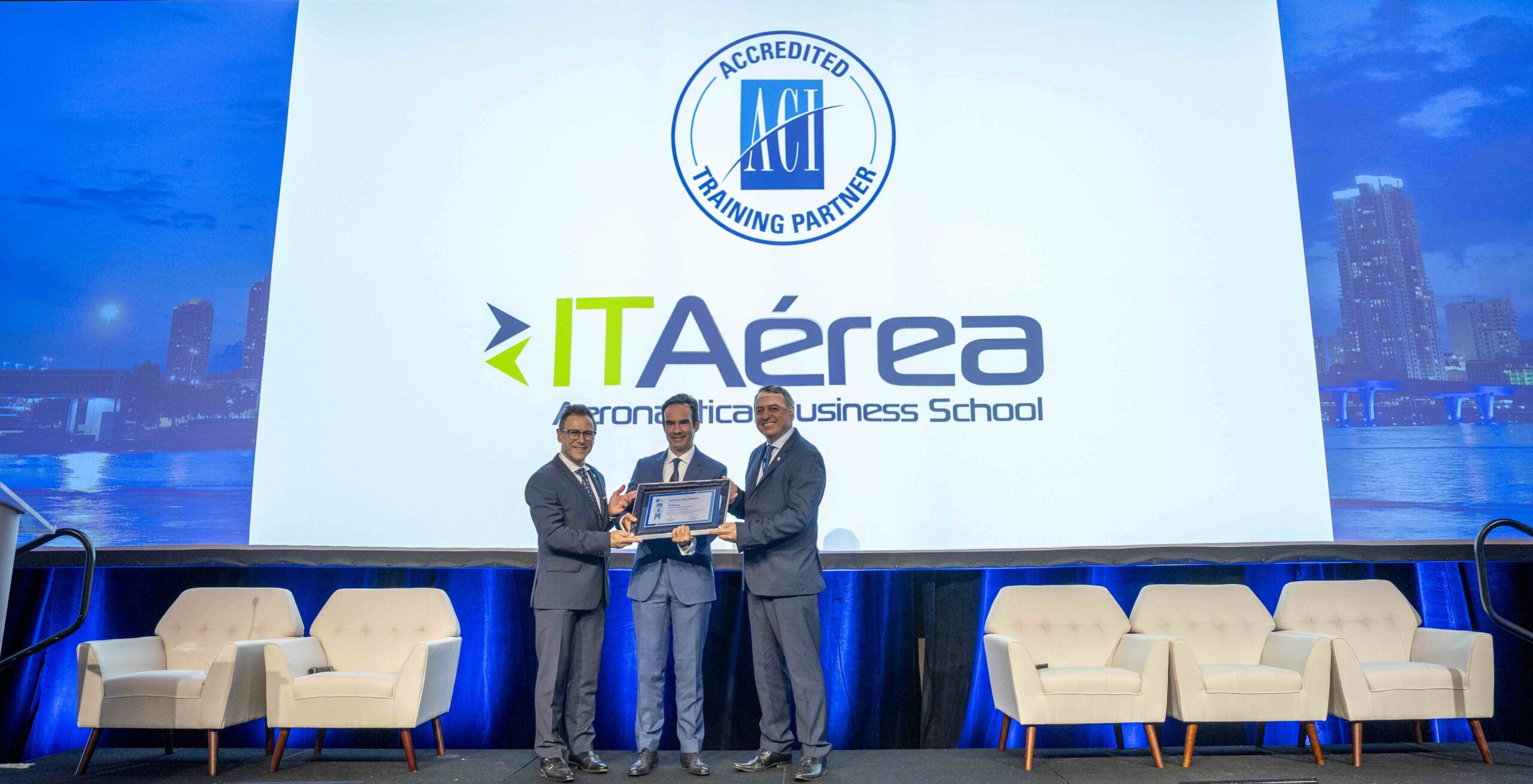
Recruiters look at what you know, who taught you and what recognition the programme has; the delivery mode matters less. In our case, we are a Corporate Partner of TRAINAIR PLUS, the training programme of ICAO (International Civil Aviation Organization), an accredited training partner of ACI World (Airports Council International) and a strategic partner of UNITAR (United Nations Institute for Training and Research).
If you are comparing master’s programmes in aviation, give verifiable credentials priority over delivery mode.
With the myths cleared up, let us look at why contacts matter so much in this industry.
Why contacts matter so much in aviation (and which ones you need)
Contacts matter because aviation is a small, regulated industry in which operations depend on several companies at once. Knowing the decision-makers, the next link in the chain and colleagues in other countries opens doors that are never advertised.
Executives in post: the people who know about vacancies before they are advertised
In airport and airline management, many middle-management positions are filled through recommendation: that is what we observe in the industry, not a statistic. An executive who heard you ask a good question may remember you when a vacancy comes up.
Colleagues from other links in the chain: airport, airline, ground handling and air navigation
A punctuality problem affects the airport, the airline, the ground handling agent and air navigation services at the same time. Whoever knows someone in each link solves it better and gains sideways moves: from operations to planning, or from ground handling to the commercial side.
Professionals from other countries: the network a local classroom cannot give you
Many airports are run by airport groups operating in several countries. A network with colleagues in Dubai, Addis Ababa, Lagos, Nairobi, Bogotá or Lima is worth more than many contacts in a single city. If you are weighing a generalist network against a specialised one, read MBA or master’s in aeronautics.
Knowing whom to meet is half the job; the other half is where you will meet them.
How our online master’s works from the inside
Our online master’s programmes, such as the MBA in Aviation Management (e-learning) and the Master in Sustainable Air Transport Management (executive e-learning), combine live sessions, a virtual campus open 24/7 and student accompaniment. Our 1,500-hour Master in Airport and Aeronautical Management (MGDA) follows the same model in its e-learning version.
Live sessions with a faculty of industry executives
Our own methodology is built around live sessions, delivered by our faculty: general managers, chief executive officers and heads of division in the industry. For your network, that is what counts: every session is a chance to be noticed by someone who leads teams.
Support throughout the programme and a final thesis
We accompany our students throughout the programme, and the MGDA closes with a final thesis on an air transport topic: one of your best networking tools (step 3).
With this environment in place, your network depends on you. Let us get practical.
Digital networking: how to connect with executives and colleagues worldwide
Networking online means turning every contact from the master’s into a professional relationship that continues beyond it. These are five habits, each with its reason and an industry example.
1. Arrive at every live session with a prepared question
What to do: check who is delivering the session and prepare a question about your own reality. Why it works: the lecturer leads teams, and a good question is your business card. Example: imagine an operations manager at Bogotá-El Dorado or Nairobi asking how slots are allocated at a congested airport; the lecturer will probably remember her.
2. Turn the session into a LinkedIn connection
What to do: connect with the lecturer on the same day and mention what was discussed. Why it works: a request with context gets accepted and remembered; a generic one gets lost. Example: an airline technician in Mexico City or Lagos would connect that evening with a message like this.
A three-line connection message
Hello [name], I attended your session on [topic] in the master’s programme. [Specific idea] stayed with me. I work in [area] in [city] and would like to follow your work.
3. Use your final thesis to interview industry professionals
What to do: choose a topic that requires you to talk to three to five professionals in the area you want to move into (a recommendation, not a rule). Why it works: “I am preparing my thesis” opens doors that a job request closes. Example: a ground handling coordinator at Madrid-Barajas or Dubai who wants to move into planning could interview an airline station manager and an airport planner.
4. Look after your classmates: they are your network five years from now
What to do: suggest a study group and share what you know about your airport or airline. Why it works: the person coordinating the ramp in Lima or Addis Ababa today may be running operations in a few years. Example: a messaging group with classmates from three countries builds more trust than a hundred connections.
5. Take your network offline whenever you can
What to do: use conferences and industry meetings to put faces to your contacts. Why it works: a coffee after months of messages consolidates the relationship. Example: we organise industry meetings, and we held the XIII Airport Sector Meeting in Lima from 25 to 29 September 2026, with ACI-LAC (ACI Latin America and Caribbean) and ACI World.
The method works in any delivery mode, but it does not perform equally in all of them.
Online or on-campus master’s: what each offers your professional network
Which is better, an online or an on-campus master’s? For your network, it depends more on how you network than on the delivery mode: online gives you international reach and compatibility with work; on-campus gives you density and spontaneous contact.
| For your professional network | Online master’s | On-campus master’s | What depends on you |
|---|---|---|---|
| Who you study with | Professionals from several countries and areas of the industry | Mostly classmates from the city or region where the campus is | Choosing a programme with varied student profiles |
| Contact with lecturers | Live sessions and programme channels | Classroom, breaks, corridors | Asking questions and following up |
| Informal contact | You have to make it happen | It happens on its own | Suggesting groups and conversations |
| Compatibility with shifts and travel | High | More limited | Blocking the sessions in your calendar |
| Reach of the network when you finish | International, if you look after it | Local and denser | Keeping it alive |
That said, the table describes tendencies, not rules, and in both modes the right-hand column carries the most weight. The rest depends on the school, and you can ask about it.
What to ask a school before enrolling in an online master’s
Ask any school that offers an online master’s in aviation management these eight questions:
- Are there live sessions? How often?
- Who teaches: working professionals or academics?
- Are the sessions recorded?
- Is there group work?
- Which countries and sectors do the students come from?
- Is there an alumni network or community?
- Are there in-person events open to online students?
- What career guidance or job board is available for online students?
If you write to us, we will answer all of them.
Frequently asked questions about networking in an online master’s
What is the difference between online and offline networking?
Online networking extends your reach to other countries and areas, but it demands initiative and consistency. Offline networking provides depth and spontaneity, because trust builds faster in person. They do not compete: the most effective approach is to open contacts online and consolidate them face to face when the opportunity arises.
How much time per week should I spend on networking during the master’s?
There is no fixed figure. A small weekly routine works better than a one-off effort: prepare a question for the live session, send one connection request with context and follow up once. Sustained throughout the programme, it builds more of a network than any contact marathon.
Is LinkedIn useful for networking in aviation?
Yes. Many management profiles from airports, airlines, ground handling companies and authorities are active on LinkedIn. Treat it as your public CV: in English and in any other working language you use, with your responsibilities and the master’s you are taking. Use it to follow up, not to ask for a job.
Can I network if I don’t work in the industry yet?
Yes, although you will lean more on the programme: live sessions put you in touch with executives, and the final thesis gives you a legitimate reason to talk to professionals in the area that interests you. To work out whom to approach, review our aeronautical employment map for Spain and Latin America.
Conclusion: your network starts at the first session
Networking in an online master’s does not depend on the delivery mode, but on what you do with it: sessions, the thesis and LinkedIn give you the opportunities, and the initiative is yours. If you want to see how we combine live sessions, the virtual campus and student accompaniment, browse our master’s programmes and courses, including the MBA in Aviation Management and the Master in Sustainable Air Transport Management in e-learning format. And if you would rather we advise you on your profile and country, write to us from the programme page: we will answer the questions in this guide.