.jpg)








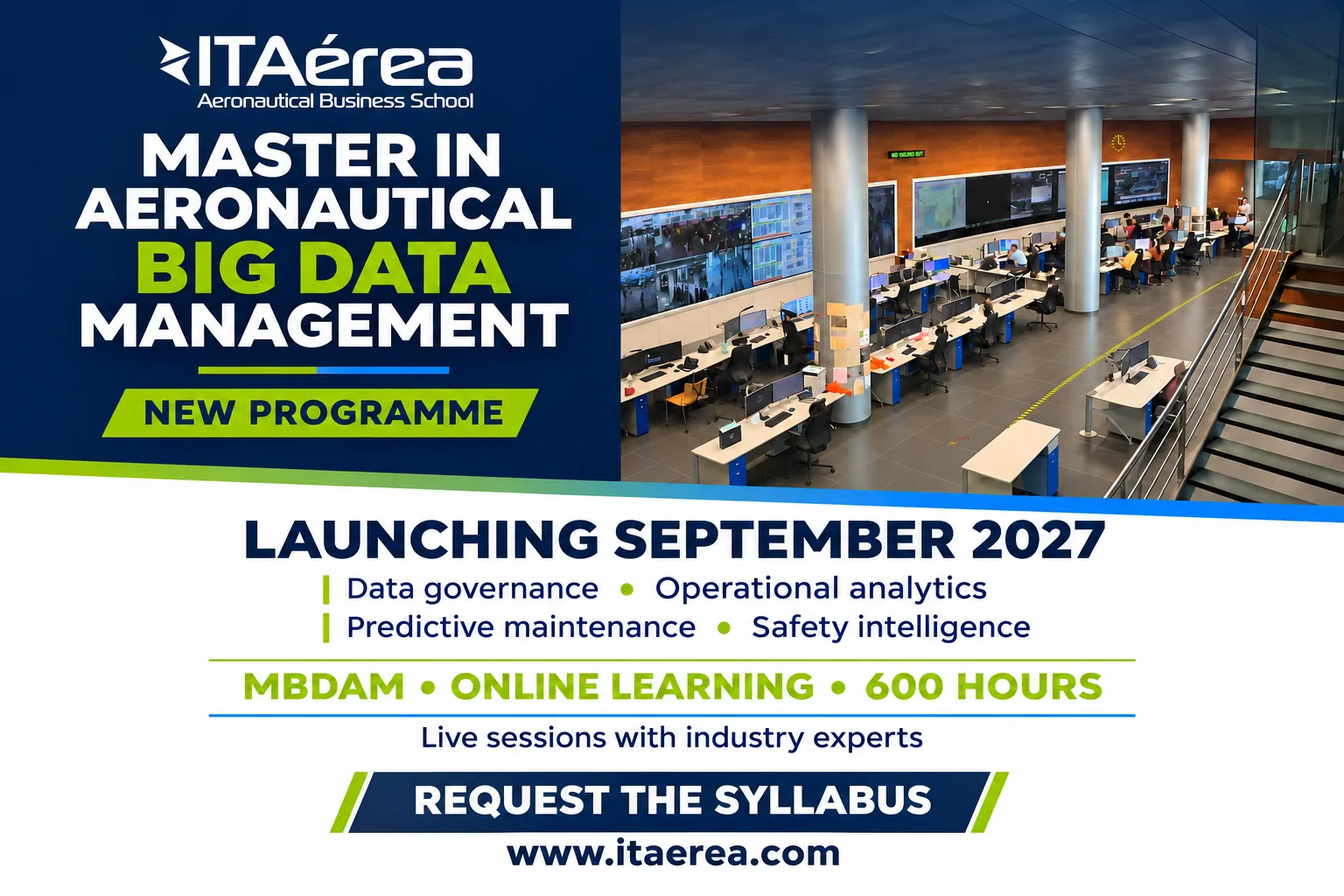
ITAérea Aeronautical Business School is expanding its professional training with the launch of the Master in Aeronautical Big Data Management (MBDAM), beginning in September 2027. The programme provides a comprehensive understanding of Big Data management, data governance, advanced analytics and business intelligence, enabling participants to transform complex datasets into actionable insights.
Through a practical, industry-focused approach, students will learn to optimise operational efficiency, enhance safety and sustainability, improve decision-making and drive innovation across airlines, airports, air navigation, aircraft manufacturing, MRO and other key sectors of the aviation value chain. One of the core values of the MBDAM programme is its select group of teachers, which consists of active professionals working in top aeronautical companies, assuring that our students receive the latest knowledge related to the industry.
Airports, airlines, maintenance providers and aerospace manufacturers generate information through almost every aspect of their activities. Making effective use of that information requires reliable processes, clear responsibilities and professionals who understand the operational context behind the data.
MBDAM has been developed to help participants connect these elements, bringing together data strategy, governance and analytical applications within a specialised aviation programme.
As explored in ITAérea’s article on the role of the aviation data analyst, effective analysis requires both analytical skills and an understanding of the sector. Professionals must interpret information within aviation’s operational, commercial and regulatory environment, then communicate findings that support management decisions. These capabilities are relevant to roles in business intelligence, airport performance, data governance and digital transformation.
The practical relevance of these skills can be seen in the work of companies providing aviation data platforms and analytical solutions:
- Airbus — aircraft data and predictive maintenance. Through its Skywise platform, Airbus supports the use of aircraft data for predictive maintenance, operational improvements and fleet performance. This illustrates how information generated by aircraft can inform maintenance planning and technical decision-making.
- Cirium — aviation data and business intelligence. Cirium provides datasets and analytics covering airline schedules, flight tracking, fleets, traffic and fares. Its services support decisions ranging from network planning and aircraft asset analysis to operational performance monitoring, demonstrating how different datasets can inform both daily operations and long-term strategy.
- SITA — airport operations and resource optimisation. SITA’s Airside Optimizer uses airport data to support airside operations, including taxi-time analysis and emissions monitoring. It provides an example of how operational information can help airports coordinate activities and assess opportunities to improve efficiency.
These industry examples illustrate applications relevant to MBDAM’s subject areas: connecting reliable information with operational needs, interpreting performance and supporting informed decisions.
The programme begins with data governance, strategy and organisational culture, examining how aviation organisations can manage data as a strategic asset. Participants will explore data ownership, quality, security, traceability and ethical use, alongside the coordination required between business and technology teams.
These foundations support the programme’s examination of data applications throughout aviation:
- Airport management and passenger experience: passenger flows, terminal occupancy, queue monitoring, capacity forecasting, baggage processes and commercial performance.
- Airline operations and commercial intelligence: route profitability, revenue management, disruption analysis, aircraft utilisation, fuel efficiency and demand forecasting.
- Air navigation and air traffic management: traffic flows, sector capacity, controller workload indicators, flight efficiency and the quality of safety-critical information.
- Aeronautical manufacturing: engineering and production data, supply chain performance, quality control, configuration management and traceability.
- Maintenance and continuing airworthiness: aircraft technical records, reliability indicators, component histories, health monitoring and predictive maintenance.
- Ground handling and cargo: turnaround performance, resource allocation, baggage handling, cargo tracking and service-level monitoring.
- Safety, security and compliance: occurrence reporting, risk indicators, audit information, regulatory reporting and early risk detection.
- Aeronautical and meteorological information: digital datasets, information exchange, publication workflows and operational weather information.
By covering these interconnected activities, MBDAM will give participants a broader view of how information moves between aviation organisations and how its quality affects decisions throughout the sector.
Practical case studies will connect the syllabus with management challenges. Participants will examine subjects such as creating a data governance model for an aviation group, developing a passenger flow dashboard for an international airport and analysing airline disruptions.
Other cases will address traffic demand and sector capacity, predictive maintenance for an airline fleet, ground handling performance and the early identification of risks through safety and operational data. The programme also includes cases involving aeronautical information updates and the continuity of meteorological information during changing weather conditions.
Given the evolution of the aeronautic and aviation industry, the demand for data science professionals is growing in roles such as Aviation Data Manager, Business Intelligence Analyst, Data Governance Manager and Aviation Operations & Performance Analyst. Other career paths include predictive maintenance and reliability analysis, aeronautical information management, and digital transformation consulting across airlines, airports, air navigation providers, maintenance organisations and aerospace manufacturers.
These roles encourage participants to consider the complete decision-making process: identifying the operational question, assessing the available information, recognising data quality requirements and determining how findings can support action.
The 2027–2028 edition comprises 600 hours of online learning, delivered through ITAérea’s Virtual Campus. The methodology includes live sessions with teachers via Zoom, access to programme materials, tutoring and academic monitoring.
This format enables participants to engage with the programme remotely while maintaining contact with teachers and receiving support throughout their studies. Assessment and a Master’s Thesis form part of the learning process. Successful participants will obtain the Master in Aeronautical Big Data Management degree issued by ITAérea Aeronautical Business School.
The programme is intended for university graduates and professionals from the aeronautical and airport sector, including those without a university degree. A minimum English level of B2 is recommended.
For aviation professionals seeking to strengthen their understanding of data, MBDAM offers an opportunity to connect existing sector experience with new management capabilities. Its focus extends from the governance of information to its practical use in operational planning, performance monitoring and organisational improvement.
With the launch of MBDAM in September 2027, ITAérea continues to develop specialised education around the challenges facing aviation organisations and the professionals who manage them.
Request the syllabus and further information
To learn more about the Master in Aeronautical Big Data Management, its methodology and admission requirements, contact info@itaerea.es.
Explore ITAérea’s educational offering at www.itaerea.com.